Brazil Beyond the First Impression
Paraguay A Country for the Curious
Some countries make the travel magazines year after year.
Others barely seem to get a mention.
Before I started working on this Discover Series, Paraguay fell firmly into the second category for me.
I knew where it was. I knew it was landlocked. I knew it sat there in the middle of South America surrounded by countries travelers tend to talk about much more often.
Beyond that?
Not much.
So I started researching.
And Paraguay kept making me ask questions.
Why does Guaraní remain such an important part of the country? What’s actually out there in the Chaco? Why did rivers keep appearing in photographs of a landlocked country? What were those enormous ruins? And how had I never heard much about any of this before?
The questions became part of the fun.
Paraguay doesn’t seem to hand you an obvious list of famous places and say, start here.
You have to look a little harder.
Apparently, I like that.
Not Every Travel Treasure Is Famous
There is something easy about planning a trip around places you already recognize.
You’ve seen the skyline. You know the ruins. You’ve probably seen the famous beach photographed from exactly the same angle a hundred times.
Paraguay doesn’t give you much of that.
At first, I wondered whether that would make it harder to put together this series.
Instead, it made me more curious.
The country stretches from the greener landscapes of the east into the enormous Gran Chaco in the west. There are farms and forests, wetlands and cities, small communities and roads that seem to go on forever.
And then there are the rivers.
That was my first real surprise.
For a country without an ocean coastline, Paraguay has an awfully strong relationship with water. The Paraguay and Paraná rivers have shaped where people live, how goods move and how the country connects with its neighbors.
Once I understood that, I started seeing the rivers everywhere.
Getting to Know Asunción
Asunción wasn’t quite what I expected either.
I suppose I had some vague idea that I’d find a neatly defined historic center surrounded by a modern capital.
It’s not quite that tidy.
The city spreads toward the Paraguay River through neighborhoods and trees. At street level, older churches and civic buildings share space with newer towers, shops, plazas and buildings showing every bit of their age.
Some have been restored.
Some clearly haven’t.
I think I’d enjoy that mixture.
I’d also probably abandon any carefully planned walking route fairly quickly.
A plaza with some shade and a bench is usually enough to distract me. Sit for a while and you start noticing who actually uses the space. People meet. Someone passes through on the way somewhere else. Someone else isn’t going anywhere at all.
That’s when a city starts becoming more than its buildings.
Asunción strikes me as a place where I’d want to give myself enough time to wander and see what happens.
Following the Rivers
Once I started paying attention to Paraguay’s rivers, they became difficult to ignore.
The Paraguay River runs through the heart of the country, connecting communities and carrying trade through a nation with no direct access to the sea.
Boats, ports, wetlands and riverfront neighborhoods are all part of that story.
I can easily imagine myself sitting somewhere along the water watching boats go by for considerably longer than necessary.
I’ve done worse things with an afternoon.
Then the Paraná River introduces something completely different.
Itaipú.
I don’t normally put hydroelectric complexes high on my travel wish list, but the scale of this one made me stop.
Shared by Paraguay and Brazil, Itaipú is enormous. This isn’t a quiet little riverside stop. It’s engineering, concrete, water and power on a scale that seems almost difficult to understand from photographs.
Would I go see it?
Absolutely.
Sometimes the places that don’t sound particularly interesting on paper turn out to be the ones you talk about afterward.
History That Left Me With Questions
Then I found the Jesuit mission ruins in southern Paraguay.
This was another how did I not know about these? moment.
The photographs are striking. Massive stone walls, arches, courtyards and carved details remain from communities established centuries ago.
But the more I read, the less comfortable I became thinking about them simply as beautiful ruins.
Their history involves religion, colonization, Indigenous communities, labor, cultural exchange, control, adaptation and conflict. That’s a lot more complicated than admiring old stonework.
And perhaps that’s exactly why I’d want to see them.
I like historic places that make me ask questions rather than simply give me something pretty to photograph.
I’d still photograph the arches.
Let’s be realistic.
But I’d want to understand what happened there too.
The Details I Didn’t Know to Look For
Paraguay kept introducing me to things I’d never encountered before.
Ñandutí was one of them.
I had to look it up.
The name is associated with intricate lacework made in delicate circular and radiating patterns. Once I started looking at photographs, I found myself zooming in to see the individual stitches.
That’s a dangerous thing for me to discover while researching.
One photograph becomes five. Then I want to know how it’s made. Then where it’s made. Then what else people are making.
Suddenly I’m looking at embroidery, woven goods, pottery, basketry and markets.
And that’s where I’d want to see them.
Not necessarily arranged specifically for tourists, but mixed among produce, food, household goods and everything else people are actually buying.
Markets have a way of doing that.
You go looking for one thing and end up learning about ten others.
I Apparently Need to Try Tereré
Then there was tereré.
I knew mate, of course.
Cold mate prepared with water and often herbs was new territory.
Given Paraguay’s heat, the cold part makes perfect sense.
What interested me more was how often I encountered photographs of people carrying the insulated containers and drinking vessels used for it. This wasn’t something appearing occasionally in a restaurant photograph. It was clearly part of everyday life.
So I kept reading.
And what started as what exactly are they drinking? turned into learning about the social tradition around sharing it.
That’s the kind of thing I love discovering about a place.
Not necessarily some enormous cultural event scheduled for visitors.
Just something people do.
Would I know exactly what I was doing the first time someone handed me tereré?
Probably not.
But I’d certainly try it.
And Then There’s the Food
Paraguay also introduced me to chipa.
Cassava starch and cheese.
I’m listening.
It can come in rings, twists and other shapes, and I’d have very little objection to trying several versions strictly in the interest of thorough travel research.
Then I encountered sopa paraguaya.
Which is not soup.
That required further investigation.
It’s a dense, savory cornbread traditionally made with ingredients including cornmeal, cheese, onion, milk and eggs.
At this point, Paraguay and I are getting along quite nicely.
Food is one of the easiest ways for me to start understanding a place because ingredients tell you things. What grows locally? What has been available historically? What gets served at home rather than in restaurants? What do people make when family comes over?
Those are the things I’d want to find out.
Preferably while eating.
Into the Chaco
And then Paraguay changes completely.
The Gran Chaco covers much of the country’s western half, and this is the part that made me realize just how much variety I’d underestimated.
This isn’t somewhere I’d simply rent a car and head off because a road looked interesting.
The distances are significant. Conditions can be difficult. Heat is a serious consideration, and preparation and local knowledge matter.
But the landscape fascinates me.
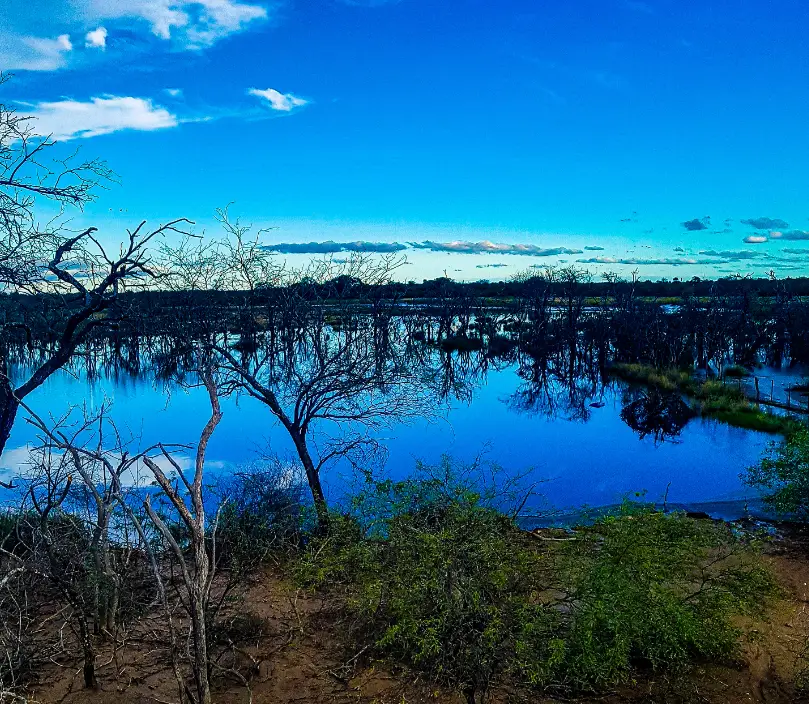
Dry forests give way to open grasslands and seasonal wetlands. Wildlife has adapted to an environment that can look almost empty until you start paying attention.
That immediately makes me want to pay attention.
I’d be watching the tree line, scanning the grass and probably annoying everyone in the vehicle with some version of:
Did you see that?
Whether there was actually anything there remains another question.
The Chaco wouldn’t be casual sightseeing for me. It’s the part of Paraguay I’d want to research much more carefully before ever attempting to visit.
But I’d want to.
Wait. Paraguay Has Waterfalls?
Apparently it does.
That was another research detour.
Waterfalls were nowhere in my mental picture of Paraguay when I started this project. Yet tucked into some of the country’s greener landscapes are cascades running through forest and rock.
They’re not necessarily enormous.
I think that’s part of why they appealed to me.
I don’t need every waterfall to be Iguazú.
Sometimes I’d rather follow a trail through the trees, hear water somewhere ahead and discover something I wasn’t expecting.
Those little surprises tend to stick with me.
And Paraguay was becoming surprisingly good at them.
The Roads Between Places
The more photographs I looked through, the more interested I became in the countryside itself.
Farmland. Small towns. Roadside stands. Family farms. Churches. Long roads.
Not necessarily anything you’d circle on a map before leaving home.
But that’s never stopped me.
I’ve taken plenty of roads simply because I wanted to know where they went. Sometimes the answer is nowhere particularly exciting.
That’s okay too.
Because those drives are often when I see how people actually live outside the places built around visitors.
A field being worked. Something for sale beside the road. A tiny church. Someone sitting outside a house under a tree.
None of those will make a Top Ten Paraguay list.
They don’t need to.
Paraguay Kept Making Me Curious
By the time I finished researching this series, I realized something.
I still had a lot of questions about Paraguay.
I think that’s why I liked it.
I wanted to know more about the missions after seeing the ruins.
Ñandutí sent me down an entirely unexpected rabbit hole.
Tereré made me curious about something people carry around every day.
The rivers completely changed the way I’d pictured a landlocked country.
And the Chaco made Paraguay seem much larger and wilder than I’d imagined.
I started with very few expectations.
That left plenty of room to be surprised.
For the Traveler Willing to Notice
Paraguay probably isn’t going to replace its neighbors on everyone’s South America wish list.
I don’t think it needs to.
What appeals to me is precisely that I had to work a little harder to discover it.
There wasn’t one landmark that suddenly made me think, I have to go to Paraguay.
It happened gradually.
A river.
Some lace I’d never heard of.
An old stone doorway.
A food with “soup” in its name that isn’t remotely soup.
A vast landscape in the west.
A road disappearing somewhere I couldn’t see.
Put them together and I started seeing a country I’d barely thought about before.
Would Paraguay become exactly the place I’m imagining if I actually went?
Maybe.
Maybe not.
That’s one of the reasons we travel.
But I know this much:
I’m curious enough now to want to find out.
Until next time, happy traveling!





Join the Discussion