Brazil Beyond the First Impression
Namibia: Where the Landscape Sets the Pace
Namibia has been on my radar for years.
But if I’m being fair, most of what I associated with it came from the same handful of images.
Wildlife.
Red dunes.
Maybe a photograph of Deadvlei with those dark trees standing against an almost impossible landscape.
Then I started working on this Discover Series.
And Namibia got considerably bigger.
There were mountains I hadn’t really thought about. An Atlantic coastline that looked nothing like the coast I imagined. Enormous canyons. Rock formations. Old mining towns. Desert-adapted wildlife.
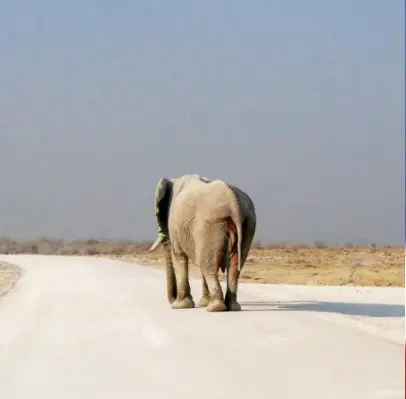
And roads.
Lots and lots of roads disappearing toward a horizon that seemed ridiculously far away.
That’s when Namibia really got my attention.
I started thinking less about individual places I wanted to see and more about what it might be like to travel between them.
Because Namibia doesn’t look like a country where I’d want to rush from one attraction to another.
It looks like somewhere I’d want to drive.
The Road May Be Part of the Reason to Go
I have a weakness for road trips.
Especially the kind where the scenery keeps changing and you have no particular desire to reach the next stop quickly.
Namibia seems particularly dangerous for someone like me.
I’d probably start with a perfectly reasonable itinerary.
Then I’d see a road disappearing toward some mountains.
Or an overlook.
Or something moving beside the road.
And there goes the schedule.
The distances in Namibia are significant, and many roads are gravel. That’s something I’d need to take seriously when planning a trip.
But those same distances are part of what appeals to me.
There’s room here.
Not just physical space, although there’s certainly plenty of that.
There’s room to watch the landscape change.
I’d want time for that.
About Those Dunes
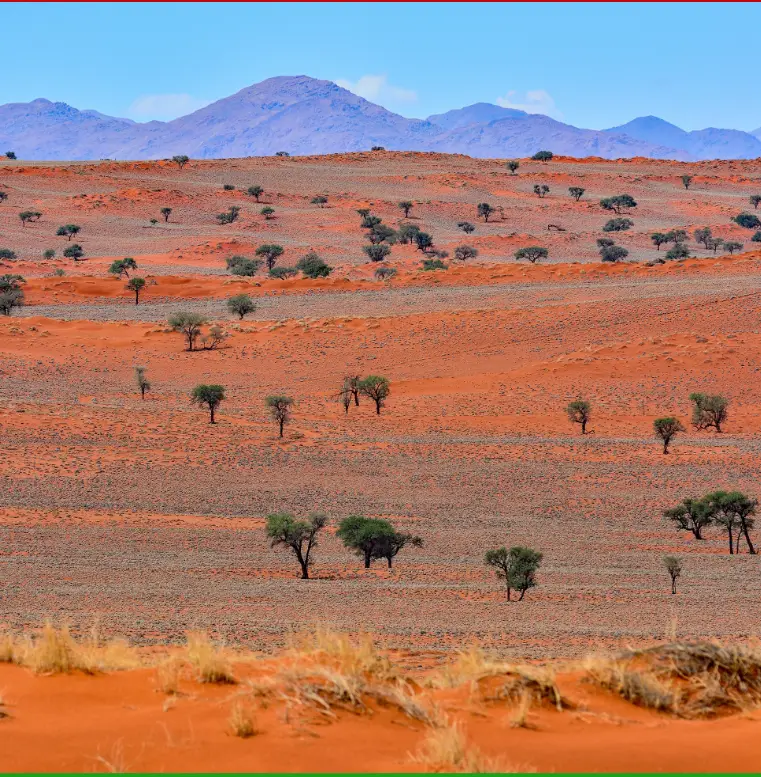
Of course I want to see Sossusvlei.
There’s no pretending otherwise.
The enormous dunes of the Namib are probably among the most recognizable images of Namibia, and this may be one famous place where I’d happily join everyone else.
But I’d want to see what happens when the light changes.
Early morning.
Late afternoon.
Shadows moving across the sand.
I suspect I’d take far too many photographs of essentially the same dune and insist they were all completely different.
They would be.
At least to me.
And then there’s Deadvlei.
This is one of those places I’ve seen in photographs for years without really stopping to think about what I was looking at.
Ancient dark camelthorn trees standing on pale clay, surrounded by red dunes under an intensely blue sky.
It almost looks constructed.
Except it isn’t.
That’s probably the moment I’d put the camera down for a while.
Sometimes you need to actually look at something before you start trying to capture it.
Then the Desert Runs Into the Ocean
This may be the part of Namibia that surprised me most.
The Namib Desert doesn’t simply end somewhere before the coast.
It reaches the Atlantic.
That combination fascinates me.
Sand. Fog. Cold ocean. Shipwrecks.
And a coastline with the rather uninviting name Skeleton Coast.
Naturally, I want to see it.
The more I researched this part of Namibia, the stranger it became. Fog rolling inland from the Atlantic. Desert-adapted wildlife surviving in conditions that seem determined to discourage almost everything from living there.
Then there are the shipwrecks.
Some are visible along a coastline that has been difficult for sailors for centuries.
I’m not sure “beautiful” is the word I’d use for the Skeleton Coast.
I’d still want to stand there.
Swakopmund Changes the Mood
Then Namibia does something completely different again.
Swakopmund sits between the desert and Atlantic with architecture influenced by the country’s German colonial history.
Palm trees. Historic buildings. Ocean.
And dunes practically next door.
It’s an odd combination.
Which means I’d probably like it.
After days of driving through enormous landscapes, I could see myself appreciating a café, a walk through town and a little time beside the water.
Then I’d probably start wondering what was farther up the coast.
This is why my itineraries get into trouble.
Yes, There Is Wildlife
For a series deliberately looking beyond safari, Namibia certainly isn’t going to let me ignore its wildlife.
Nor would I want to.
Etosha National Park is one of the country’s best-known wildlife destinations, and its enormous salt pan creates an environment unlike the safari landscapes I usually picture.
But what appeals to me most is the waiting.
Find water.
Stop.
Watch.
See what happens.
That sounds considerably more interesting to me than racing around trying to check animals off a list.
Elephants, giraffes, antelope, zebra and predators may appear.
Or perhaps nothing does for a while.
That’s wildlife.
It doesn’t work for us.
We’re visiting its world.
Wildlife Where I Wouldn’t Expect It
Outside Etosha, Namibia’s animals became even more interesting to me.
Desert-adapted elephants.
That sent me researching.
Elephants living in an environment this dry wasn’t something I’d really thought about before.
Then I started reading about the ways wildlife moves through these enormous landscapes in search of food and water.
Suddenly the apparently empty spaces didn’t seem quite so empty.
That’s another reason I’d want to travel slowly here.
I’d be looking.
Probably constantly.
And probably asking whoever was with me:
Did you see that?
Whether there was actually something to see is another matter.
Rocks, Mountains and Very Old Stories
Then I found Spitzkoppe.
Granite peaks rising abruptly from the desert will get my attention every time.
The landscape alone would be enough to put it on my list.
But Namibia’s rock art adds another layer.
Places such as Twyfelfontein preserve engravings created long before anyone was traveling through Namibia with a camera and a rental vehicle.
I always find places like that grounding.
We arrive thinking we’re exploring somewhere new.
People have been observing, traveling through and making sense of these landscapes for thousands of years.
I’d want enough time to look closely.
Not race through because the next stop was two hours away.
Apparently Namibia Has a Giant Canyon Too
This was another wait, what? discovery.
Fish River Canyon.
I knew about the dunes.
I knew about Etosha.
Somehow one of the world’s largest canyons had escaped my Namibia mental file.
That file clearly needed work.
The scale looks enormous, with layers of rock dropping toward the river far below.
This is exactly the kind of place where I’d walk to an overlook, say wow, take a photograph, move ten feet and take essentially the same photograph again.
Possibly several times.
I’m consistent.
And Then It Gets Dark
All that open space has another advantage.
Dark skies.
Very dark skies.
Namibia has some exceptional places for stargazing, and after seeing photographs of the night sky over the desert, I’m fairly certain I’d be outside long after any sensible bedtime.
That’s one of the things artificial light makes easy to forget.
The stars haven’t disappeared.
We just usually can’t see most of them.
Take away the cities, streetlights and glowing buildings and suddenly the sky looks completely different.
I’d want one night with nowhere to go.
No schedule.
No reason to get up early.
Just look up.
The Namibia I Didn’t Expect
When I started putting together this series, I thought wildlife would be the Namibia story.
It’s certainly part of it.
But it’s no longer the part that interests me most.
I keep coming back to the landscapes.
The dunes.
The coast.
Granite rising out of the desert.
A canyon I somehow didn’t know existed.
Roads stretching through enormous spaces with very little telling you to hurry.
And wildlife appearing in places where survival itself seems unlikely.
Namibia feels like somewhere the space between destinations matters almost as much as the destinations themselves.
That’s probably why the road-trip idea keeps pulling at me.
I’d want a vehicle, a sensible plan, plenty of time and enough flexibility to ignore that sensible plan occasionally.
Because I have a feeling Namibia is one of those places where I’d start the day knowing exactly where I was going.
And somewhere along the road, I’d find a reason to stop.
Until next time, happy traveling!





Join the Discussion